Edinburgh, Scotland's ancient capital, sits at 47 meters above sea level — but this average elevation conceals one of the most dramatic urban landscapes in Europe. The city is built on a cluster of volcanic hills and ridges rising from the Firth of Forth coastal plain, creating a skyline of crags, castles, and dramatic rock faces that has inspired writers and artists for centuries. Edinburgh's topography has literally shaped its history: the Castle Rock, a 130-million-year-old volcanic plug, made the city a natural fortress.
Key Facts at a Glance
| Elevation above sea level | 47 m |
|---|---|
| Lowest point (city area) | 0 m |
| Highest point (city area) | 251 m |
| Coordinates | 55.9533 N, 3.1883 W |
| Country / Region | Scotland, UK |
Topography: How is the City Shaped?
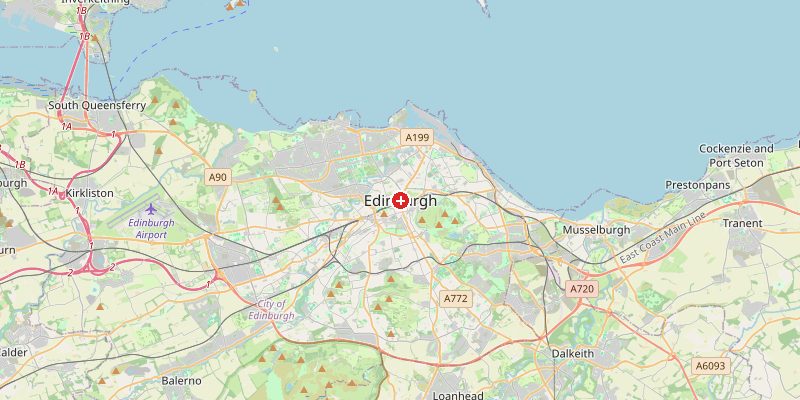
The city's defining geological feature is the Castle Rock (130 m), an ancient volcanic plug rising steeply above the surrounding plain. The Royal Mile runs along a volcanic ridge from the Castle eastward down to Holyrood Palace at 50 m. Arthur's Seat (251 m), an extinct volcano within the city, dominates the eastern skyline. The New Town to the north is built on lower, flatter ground at 30–60 m, while the Water of Leith valley cuts through at 10–30 m.
Elevations by District
| District / Area | Elevation |
|---|---|
| Old Town / Castle Rock | 100–130 m |
| Royal Mile (Castle to Holyrood) | 50–130 m |
| New Town | 30–60 m |
| Arthur's Seat (Holyrood Park) | 150–251 m |
| Leith (port) | 0–15 m |
| Morningside / Bruntsfield | 80–120 m |
Climate and Altitude: How Elevation Shapes the City
At 47 m, Edinburgh's climate is strongly shaped by its northern latitude (56°N) and proximity to the North Sea rather than its elevation. The city is famously wet and windy — the Firth of Forth channels cold North Sea winds into the city. The volcanic hills create local weather variation: Arthur's Seat receives notably more rain and wind than the sheltered New Town below. Snow occurs most winters, though rarely settling for long at sea level.
Interesting Facts About Edinburgh's Elevation
- Edinburgh Castle sits on a volcanic plug formed 340 million years ago during the Carboniferous period — one of the most ancient geological features under any European capital.
- Arthur's Seat (251 m), an extinct volcano in the middle of the city, last erupted approximately 350 million years ago.
- The city's topography inspired the term "crag and tail" geology — a hard volcanic plug (crag) protects a tapering ridge of softer rock (tail) behind it, exactly like Castle Rock and the Royal Mile.
- Edinburgh receives about 700 mm of rain per year — drier than Glasgow to the west, which is shielded from Atlantic moisture by Edinburgh's hills.
Cities Comparison – Elevation in the Region
| City | Elevation |
|---|---|
| Glasgow | 15 m |
| Dundee | 25 m |
| Newcastle (ENG) | 25 m |
| Aberdeen | 65 m |
Frequently Asked Questions About the Elevation of Edinburgh
What is the elevation of Edinburgh?
Edinburgh sits at an average of 47 m above sea level. Elevations range from 0 m at Leith's port to 251 m at the summit of Arthur's Seat, an extinct volcano in the city center.
Why is Edinburgh built on hills?
Edinburgh's hills are ancient volcanic plugs and lava flows from eruptions 340–350 million years ago. The hard volcanic rock resisted glacial erosion, leaving steep crags above the surrounding plain.
What is Arthur's Seat?
Arthur's Seat is an ancient extinct volcano rising 251 m in the middle of Edinburgh, within Holyrood Park. It last erupted about 350 million years ago and is now a popular hiking destination.
Is Edinburgh windy?
Yes, notably so. The Firth of Forth channels North Sea winds into the city, and the hills create turbulent local wind patterns. The city averages about 180 windy days per year.
How does Edinburgh's topography affect its character?
The dramatic hills made Edinburgh a naturally defensible fortress city. The division between the high Old Town and the planned New Town reflects the city's layered social and architectural history.