Cape Town, South Africa's legislative capital and one of the world's most spectacularly situated cities, sits at 46 meters above sea level — but this number barely captures its extraordinary geography. The city is dominated by Table Mountain (1,086 m), one of the New Seven Wonders of Nature, which rises almost vertically from the Atlantic coast to create a iconic flat-topped backdrop visible for hundreds of kilometers at sea.
Key Facts at a Glance
| Elevation above sea level | 46 m |
|---|---|
| Lowest point (city area) | 0 m |
| Highest point (city area) | 1086 m |
| Coordinates | 33.9249 S, 18.4241 E |
| Country / Region | South Africa |
Topography: How is the City Shaped?
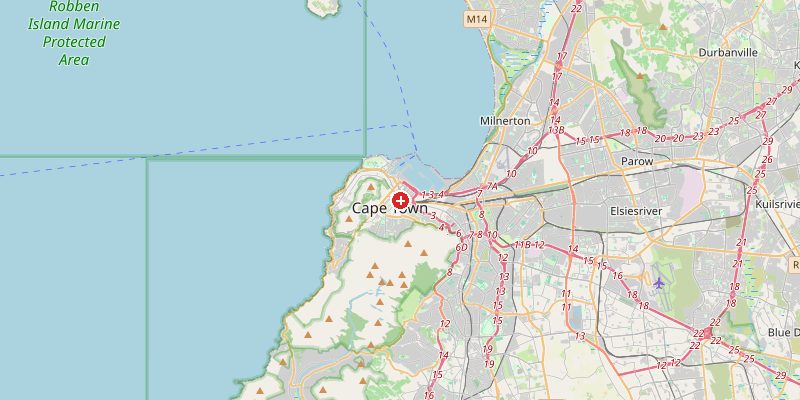
Cape Town occupies the Cape Peninsula and the flatlands of the Cape Flats. The city bowl sits at 0–100 m, hemmed in by Table Mountain to the east and south. The Atlantic Seaboard (Clifton, Camps Bay) sits at sea level on the western slopes. The Cape Flats stretching eastward are flat and low at 10–30 m. The surrounding mountain ranges — Table Mountain, Devil's Peak (1,001 m), and Lion's Head (669 m) — rise dramatically within the city boundary.
Elevations by District
| District / Area | Elevation |
|---|---|
| City Bowl / CBD | 0–80 m |
| Waterfront / Sea Point | 0–20 m |
| Camps Bay / Clifton | 0–50 m |
| Cape Flats (SE suburbs) | 10–30 m |
| Constantia Valley | 100–200 m |
| Hout Bay | 0–100 m |
Climate and Altitude: How Elevation Shapes the City
Cape Town enjoys a Mediterranean climate — one of only six such regions worldwide. Hot, dry summers and cool, wet winters are the norm. Elevation plays a major role: Table Mountain is often cloud-covered even on sunny days below, as moisture condenses around the summit. The famous "tablecloth" cloud formation is a classic Cape Town sight. The Cape Doctor — a strong southeasterly wind — keeps the city cool in summer.
Interesting Facts About Cape Town's Elevation
- Table Mountain (1,086 m) is one of the oldest mountains on Earth, estimated at over 600 million years old — far older than the Himalayas or the Alps.
- Cape Town has one of the world's most dramatic elevation gradients: from sea level to 1,086 m within just 3 km horizontal distance.
- The Cape of Good Hope, just 50 km south of the city center, sits at 249 m and was long believed to be Africa's southernmost point.
- Cape Town is the only major city in the world with a UNESCO World Heritage Site (the Cape Floral Region) within its urban boundary.
Cities Comparison – Elevation in the Region
| City | Elevation |
|---|---|
| Stellenbosch | 130 m |
| Paarl | 165 m |
| George | 227 m |
| Port Elizabeth | 55 m |
Frequently Asked Questions About the Elevation of Cape Town
What is the elevation of Cape Town?
Cape Town city center sits at approximately 46 m above sea level. The city's elevation ranges from 0 m at the beaches to 1,086 m at the top of Table Mountain.
How tall is Table Mountain?
Table Mountain stands at 1,086 m above sea level, rising almost directly from the Atlantic Ocean. Its flat summit gives it its distinctive appearance.
What is the "tablecloth" in Cape Town?
The "tablecloth" is the famous cloud formation that spills over the edge of Table Mountain when warm, moist air hits the cold mountain summit, creating a dramatic waterfall effect of cloud.
Is Cape Town's climate affected by elevation?
Yes significantly. The city bowl below experiences warm Mediterranean summers, while Table Mountain's summit above 800 m can be cold, wet, and foggy even in summer.
What is the Cape Doctor?
The Cape Doctor is the strong southeasterly wind that blows across Cape Town in summer, keeping temperatures moderate and clearing air pollution. It originates from the Indian Ocean high-pressure system.