Tokyo, the world's most populous metropolitan area with over 37 million people, sits at 40 meters above sea level at the head of Tokyo Bay on Japan's Kantō Plain. Japan's capital occupies one of the flattest parts of a volcanic island nation defined by mountains — yet even this "flat" region contains significant elevation variation, from tidal lowlands below sea level to the forested hills of western Tokyo rising over 400 m, all within the Tokyo Metropolitan Government boundary.
Key Facts at a Glance
| Elevation above sea level | 40 m |
|---|---|
| Lowest point (city area) | 0 m |
| Highest point (city area) | 408 m |
| Coordinates | 35.6762 N, 139.6503 E |
| Country / Region | Japan |
Topography: How is the City Shaped?
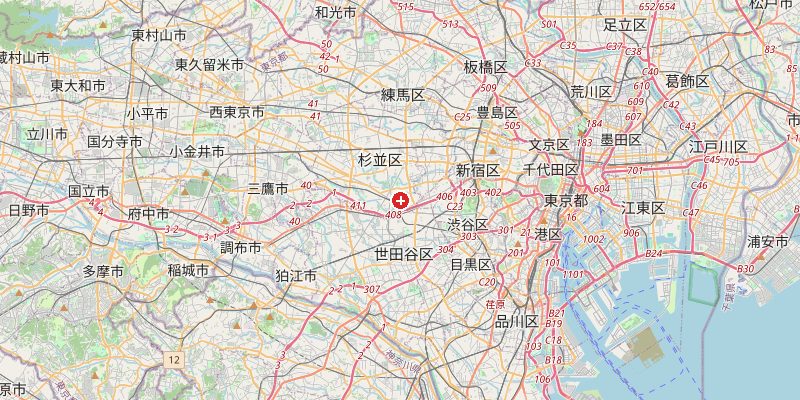
The eastern wards of Tokyo — Kōtō, Edogawa, Sumida, Adachi — occupy the Shitamachi lowlands at 0–5 m, much of it on reclaimed bay land and river delta deposits. The Yamanote ("hillside") area of central and western Tokyo sits at 20–60 m on a plateau of Kantō loam. The Tama Hills in western Tokyo rise to 300–408 m at Mount Takao (599 m), a popular hiking destination within city limits. Tokyo Bay shoreline sits at sea level.
Elevations by District
| District / Area | Elevation |
|---|---|
| Shinjuku / Shibuya (Yamanote) | 40–60 m |
| Shitamachi lowlands (east) | 0–5 m |
| Minato / Tokyo Bay shore | 0–10 m |
| Nerima / Suginami (NW) | 35–55 m |
| Hachioji (western hills) | 120–250 m |
| Mount Takao (W boundary) | 300–408 m |
Climate and Altitude: How Elevation Shapes the City
Tokyo has a humid subtropical climate with four distinct seasons — hot, humid summers driven by the Pacific monsoon, cold dry winters from Siberian high-pressure systems, and spectacular spring (cherry blossoms) and autumn seasons. The 40 m average elevation plays little role. However, western Tokyo's hills are measurably cooler and wetter. Mount Takao (599 m) sees occasional snowfall that rarely reaches the eastern lowlands.
Interesting Facts About Tokyo's Elevation
- Large parts of eastern Tokyo are below sea level — protected by one of the world's most extensive underground flood drainage systems, including the G-Cans Metropolitan Area Outer Underground Discharge Channel.
- The Tokyo Skytree (634 m tall) stands on ground just 4 m above sea level in the Shitamachi lowlands — its observation deck at 450 m is one of the highest in the world.
- Tokyo sits at the junction of three tectonic plates — it has experienced several magnitude 7+ earthquakes in recorded history, including the catastrophic 1923 Great Kanto Earthquake.
- Mount Takao (599 m) in western Tokyo is the world's most visited mountain, welcoming over 2.5 million hikers per year.
Cities Comparison – Elevation in the Region
| City | Elevation |
|---|---|
| Yokohama | 10 m |
| Kawasaki | 10 m |
| Chiba | 5 m |
| Osaka | 14 m |
Frequently Asked Questions About the Elevation of Tokyo
What is the elevation of Tokyo?
Tokyo averages 40 m above sea level. Elevations range from below 0 m in reclaimed eastern lowlands to 408 m in the western Tama Hills, with Mount Takao reaching 599 m within city limits.
Are parts of Tokyo below sea level?
Yes. Large parts of eastern Tokyo — particularly the Shitamachi area wards like Kōtō and Edogawa — lie 0–2 m below sea level. They are protected by river embankments and an extraordinary underground flood tunnel system.
Is Tokyo at earthquake risk?
High risk. Tokyo sits near the junction of the Pacific, Philippine Sea, and Eurasian tectonic plates. The 1923 Great Kanto Earthquake (magnitude 7.9) killed over 100,000 people. Modern Tokyo is engineered to strict seismic codes.
What is the G-Cans system?
The Metropolitan Area Outer Underground Discharge Channel — known as G-Cans — is a system of massive tunnels up to 32 m in diameter beneath eastern Tokyo that captures floodwater from rivers and pumps it into the Edo River, preventing the low-lying areas from flooding.
How does elevation vary across Tokyo?
Eastern wards (Shitamachi) are flat and low (0–5 m); central wards on the Yamanote plateau sit at 20–60 m; western suburbs rise gradually into the Tama Hills (100–400 m). This creates measurable climate and lifestyle differences across the city.