Washington D.C., the capital of the United States, sits at just 9 meters above sea level at the confluence of the Potomac and Anacostia rivers. The nation's capital was deliberately built on low, marshy ground that was considered strategically central between the northern and southern states — a political compromise that shaped the geography of the capital as profoundly as any architectural plan. The city's famous monumental core sits on flat reclaimed land along the Potomac, while the residential neighborhoods rise on the surrounding hills.
Key Facts at a Glance
| Elevation above sea level | 9 m |
|---|---|
| Lowest point (city area) | 0 m |
| Highest point (city area) | 125 m |
| Coordinates | 38.9072 N, 77.0369 W |
| Country / Region | District of Columbia, USA |
Topography: How is the City Shaped?
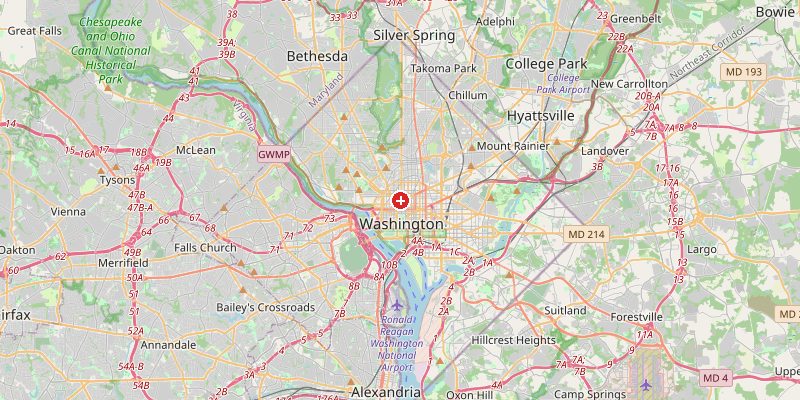
The National Mall and the monumental core sit at 5–15 m above sea level. The Potomac River defines the western boundary at 0 m. Rock Creek Park cuts through the city's center with its valley at 30–50 m, flanked by ridges reaching 90–125 m in the northwest neighborhoods. Georgetown and Cleveland Park sit on higher ground at 50–90 m. The highest point in the city is at 125 m in the far northwest, near the Maryland border.
Elevations by District
| District / Area | Elevation |
|---|---|
| National Mall / Capitol Hill | 5–15 m |
| Potomac / Georgetown waterfront | 0–5 m |
| Georgetown Heights | 50–90 m |
| Rock Creek Park valleys | 30–60 m |
| Cleveland Park / Tenleytown | 80–120 m |
| Anacostia (SE) | 5–30 m |
Climate and Altitude: How Elevation Shapes the City
Washington D.C. has a humid subtropical climate — hot, humid summers and cold winters. The city's low elevation plays no meaningful climate role. Its position on the fall line (where coastal plain meets Piedmont) means it sits in a natural temperature transition zone. Summer heat and humidity are intense; winter brings snow and ice storms. The city is also exposed to occasional major hurricanes weakened to tropical storms as they move up the coast.
Interesting Facts About Washington D.C.'s Elevation
- Much of Washington D.C.'s monumental core — including the Jefferson Memorial and parts of the Mall — is built on land reclaimed from the Potomac River marshes in the 1800s and early 1900s.
- The Washington Monument (170 m tall) stands at 15 m elevation, meaning its tip reaches 185 m above sea level — the tallest structure in DC, where buildings are limited to about 43 m by height restrictions.
- The Potomac River flooded Georgetown and the Mall regularly until the 1930s — massive flood control works along the river largely ended the problem.
- Rock Creek Park — a 1,754-acre national park running through the center of Washington — follows a river valley at 30–60 m, creating a remarkable forested corridor through the urban fabric.
Cities Comparison – Elevation in the Region
| City | Elevation |
|---|---|
| Philadelphia | 12 m |
| Baltimore (MD) | 30 m |
| Richmond (VA) | 49 m |
| New York | 10 m |
Frequently Asked Questions About the Elevation of Washington D.C.
What is the elevation of Washington D.C.?
Washington D.C. sits at an average of 9 m above sea level. Elevations range from 0 m at the Potomac River to 125 m in the far northwest residential neighborhoods.
Is Washington D.C. built on a swamp?
Partially — the original site included tidal marshes along the Potomac and Anacostia rivers. Some of the monumental core is on reclaimed land. However, much of the city was always on higher ground, and the "swamp" characterization is somewhat exaggerated.
Why was Washington D.C. built where it is?
The location was a political compromise between northern and southern states. It sits at the head of navigation on the Potomac River, midway between the northern and southern colonies. The site was selected by George Washington and French engineer Pierre Charles L'Enfant.
Does Washington D.C. flood?
The Potomac can flood during major storms. The city's low-lying areas near the rivers are most vulnerable. Climate change and sea level rise are increasing flood frequency in the lowest neighborhoods.
What is the height limit on buildings in Washington D.C.?
Buildings in Washington are limited to about 130 feet (40 m) under the Height of Buildings Act of 1910 — not, as commonly believed, to preserve views of the Capitol dome. This keeps the skyline low and the monumental buildings visually dominant.