Atlanta, the capital of Georgia and one of the American South's most dynamic cities, stands at 320 meters above sea level — making it the highest major city in the Eastern United States east of the Rockies. The city sits on the Appalachian Piedmont plateau, which gives it a significantly milder climate than the coastal lowlands of Georgia and Florida.
Key Facts at a Glance
| Elevation above sea level | 320 m |
|---|---|
| Lowest point (city area) | 238 m |
| Highest point (city area) | 409 m |
| Coordinates | 33.7490 N, 84.3880 W |
| Country / Region | Georgia, USA |
Topography: How is the City Shaped?
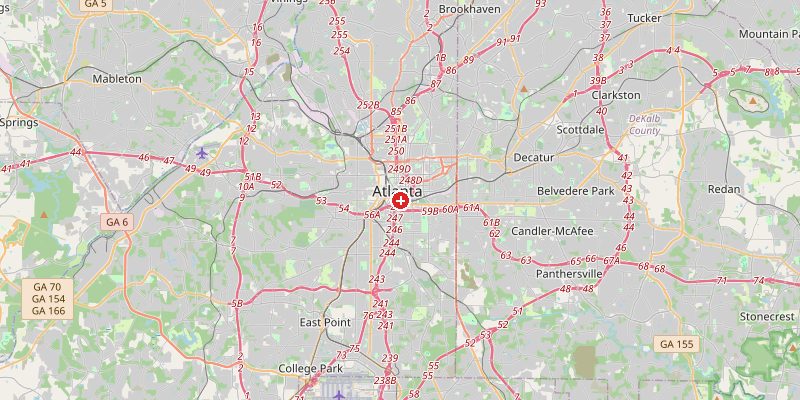
Atlanta's terrain is shaped by the southern end of the Blue Ridge Mountains and rolling Piedmont hills. The lowest point lies along the Chattahoochee River valley in the northwest at around 238 m. Downtown and Midtown sit on higher ground at 290–335 m. The northern suburbs such as Sandy Springs rise to 370–409 m.
Elevations by District
| District / Area | Elevation |
|---|---|
| Downtown / State Capitol | 299–320 m |
| Midtown Atlanta | 295–330 m |
| Buckhead | 310–370 m |
| East Atlanta / Decatur | 275–320 m |
| Chattahoochee River valley NW | 238–260 m |
| Sandy Springs / North | 370–409 m |
Climate and Altitude: How Elevation Shapes the City
Atlanta's elevation at 320 m tempers what would otherwise be an oppressively hot subtropical climate. Summers are hot and humid but several degrees cooler than coastal Georgia. The city receives significant rainfall year-round, averaging 1,300 mm annually, and occasionally sees snow or ice in winter — events that can paralyze the city due to its hilly terrain and limited winter weather infrastructure.
Interesting Facts About Atlanta's Elevation
- Atlanta is the highest major city in the eastern USA, sitting roughly 320 m above sea level on the Piedmont plateau.
- The city's elevation creates a noticeable temperature difference from coastal Georgia — summers average 3–4°C cooler than Savannah.
- Hartsfield-Jackson Atlanta Airport, the world's busiest, sits at 314 m above sea level.
- Atlanta's hilly terrain contributed to its notoriously complex highway interchanges, nicknamed "Spaghetti Junction."
Cities Comparison – Elevation in the Region
| City | Elevation |
|---|---|
| Birmingham (AL) | 196 m |
| Charlotte (NC) | 229 m |
| Nashville (TN) | 182 m |
| Chattanooga (TN) | 205 m |
Frequently Asked Questions About the Elevation of Atlanta
What is the elevation of Atlanta?
Atlanta sits at 320 m (1,050 ft) above sea level on the Appalachian Piedmont. Elevations within the city range from 238 m along the Chattahoochee River to over 400 m in northern suburbs.
Why is Atlanta so hilly?
Atlanta sits on the Piedmont Plateau, the transition zone between the flat Coastal Plain and the Appalachian Mountains. The rolling hills are a result of ancient erosion of the underlying granite and gneiss.
Does Atlanta get snow?
Yes, occasionally. Atlanta's elevation and latitude make it vulnerable to winter ice storms — even light snow or freezing rain can cause major disruptions due to the hilly roads.
How does Atlanta's elevation affect its climate?
At 320 m, Atlanta is noticeably cooler than lower-elevation cities in the Deep South. Summers are hot but not as extreme as Savannah or Jacksonville.
What is the lowest point in Atlanta?
The Chattahoochee River valley in the northwest reaches about 238 m — the lowest natural elevation within city limits.