Chicago, the "Windy City" and the US Midwest's economic hub, sits at 181 meters above sea level on the southwestern shore of Lake Michigan. Unlike many cities, Chicago's terrain is notably flat — a legacy of ancient glaciers that scraped and leveled the landscape over millions of years. The city's famous skyline rises entirely from the efforts of its architects, not from natural topography.
Key Facts at a Glance
| Elevation above sea level | 181 m |
|---|---|
| Lowest point (city area) | 176 m |
| Highest point (city area) | 205 m |
| Coordinates | 41.8781 N, 87.6298 W |
| Country / Region | Illinois, USA |
Topography: How is the City Shaped?
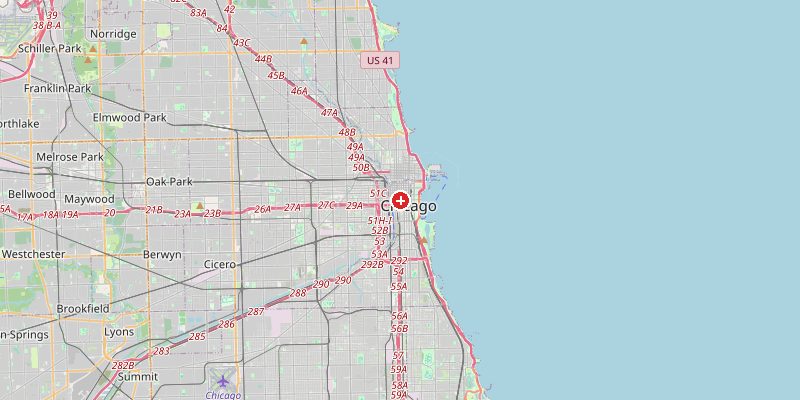
Chicago's terrain is almost perfectly flat, a consequence of its position on the floor of the prehistoric Lake Chicago — a much larger predecessor to modern Lake Michigan. The city ranges from 176 m along the lakefront to just 205 m at its highest points in the western suburbs. The Chicago River, famously reversed in 1900 to flow away from Lake Michigan, runs through the city at around 177–180 m.
Elevations by District
| District / Area | Elevation |
|---|---|
| Downtown / The Loop | 176–182 m |
| Lake Michigan Shoreline | 176–178 m |
| Lincoln Park | 178–185 m |
| Wicker Park / Logan Square | 182–190 m |
| O'Hare Airport area | 199–205 m |
| South Side / Hyde Park | 180–188 m |
Climate and Altitude: How Elevation Shapes the City
At 181 m, Chicago's elevation has no meaningful impact on its climate. The city's famous extremes — brutally cold winters, hot summers, and the notorious wind — are driven by its continental location and proximity to Lake Michigan. "Lake effect" weather moderates temperatures along the shoreline but can also bring heavy snowfall.
Interesting Facts About Chicago's Elevation
- Chicago reversed the flow of the Chicago River in 1900 — one of the greatest engineering feats in US history — to prevent sewage from flowing into Lake Michigan.
- The city sits on the ancient lakebed of glacial Lake Chicago, which is why the terrain is so flat — less than 30 m of elevation change across the entire city.
- Chicago's Willis Tower (formerly Sears Tower) stands 443 m tall from a base elevation of just 180 m — its observation deck is 628 m above sea level.
- The "Great Chicago Fire" of 1871 that destroyed the city was partly accelerated by dry winds from the flat, open prairie to the west.
Cities Comparison – Elevation in the Region
| City | Elevation |
|---|---|
| Milwaukee (WI) | 185 m |
| Detroit (MI) | 183 m |
| Indianapolis (IN) | 220 m |
| St. Louis (MO) | 142 m |
Frequently Asked Questions About the Elevation of Chicago
What is the elevation of Chicago?
Chicago sits at 181 m (595 ft) above sea level on the shore of Lake Michigan. Elevation across the city is remarkably uniform, ranging from 176 m to about 205 m.
Why is Chicago so flat?
Chicago lies on the ancient lakebed of glacial Lake Chicago. The last ice sheets scraped the region flat and deposited fine-grained sediments as the glacial lake receded about 10,000 years ago.
What is the highest point in Chicago?
The highest natural elevation in Chicago is about 205 m, in the far northwest near O'Hare Airport. There is almost no topographic variation.
Why is Chicago called the Windy City?
The nickname primarily refers to boastful politicians and civic pride, not just the wind. However, the flat, open terrain does allow strong winds to blow unimpeded across the city from the plains and off Lake Michigan.
Does Lake Michigan affect Chicago's climate?
Yes. The lake moderates temperatures in winter (slightly warmer near shore) and summer (cooler breezes). It also generates "lake effect" snow in autumn and early winter when cold air moves over the warmer lake water.